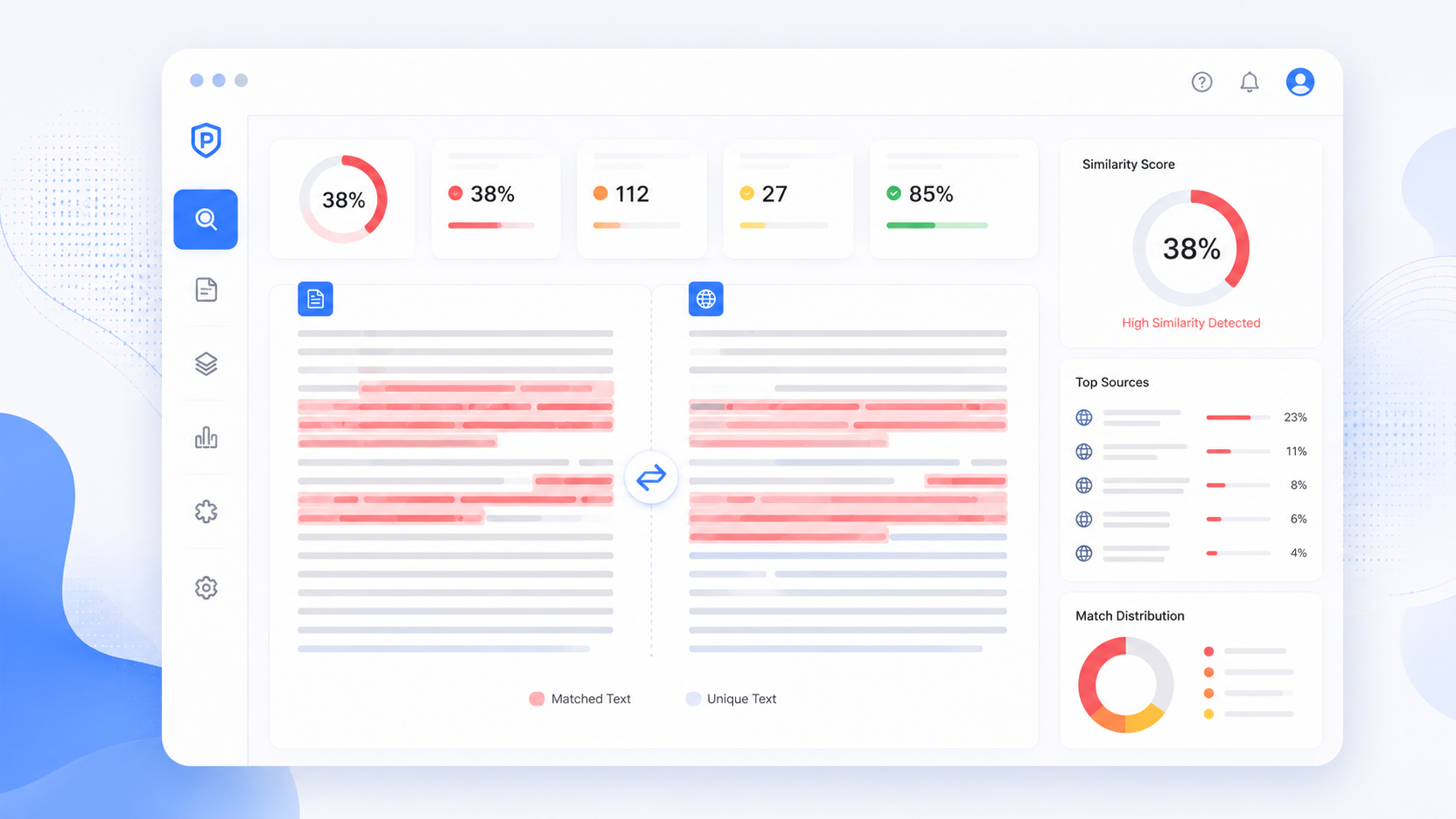
Creating original content is more important today than ever before. Whether you're a student working on an assignment, a blogger publishing articles, or an SEO professional optimizing web pages, plagiarism can cause serious problems. That's why having access to a reliable free plagiarism checker is essential for anyone who writes or publishes content online.
Plagiarism isn't just about copying someone else's work word-for-word. It includes using ideas without credit, paraphrasing too closely, and even reusing your own previous work without acknowledgment. The consequences can be severe—from failing grades and academic penalties to SEO disasters that destroy your website's search rankings.
The good news is that checking plagiarism online has never been easier. With the right tools, you can detect duplicate content, identify potential issues before they become problems, and ensure your work is truly original. In this guide, we'll explore what plagiarism is, why it matters, and how you can use our free plagiarism checker to protect your content and your reputation.
What is Plagiarism?
Plagiarism is the act of using someone else's work, ideas, or expressions without proper attribution or permission. It's presenting content as your own when it actually comes from another source. While most people think of plagiarism as copying text directly, it takes many forms that aren't always obvious.
Direct plagiarism is the most straightforward type—copying someone else's work word-for-word and claiming it as your own. This includes copying from books, articles, websites, or even other students' papers. It's the most blatant form of plagiarism and the easiest to detect with a plagiarism checker.
Mosaic plagiarism is more subtle. This happens when a writer takes phrases or sentences from multiple sources and combines them into new text without proper citation. Even though the resulting text might be original in structure, the individual components are stolen. This type of plagiarism is particularly common in academic writing and can be challenging to identify without specialized tools.
Paraphrasing plagiarism occurs when a writer rephrases someone else's ideas without giving credit. Even if you change the words, if the core idea, structure, or argument comes from another source, you need to cite it. Many students and writers mistakenly believe that changing a few words makes paraphrased content original, but this is still plagiarism.
Self-plagiarism is another form that often surprises people. This happens when you reuse your own previous work without acknowledgment. While you can't plagiarize yourself in a legal sense, academic institutions and publishers often consider self-plagiarism unethical because it presents old work as new.
Accidental plagiarism is also common. This occurs when a writer unintentionally fails to cite sources properly or paraphrases too closely without realizing it. Even though there's no intent to deceive, accidental plagiarism can still have serious consequences. This is why using a plagiarism checker is so important—it can catch mistakes you might miss on your own.
Why Plagiarism is Dangerous
The dangers of plagiarism extend far beyond simple ethical concerns. In the academic world, plagiarism can destroy your educational career. Schools and universities take plagiarism extremely seriously. Consequences can range from failing grades on assignments to suspension or even expulsion. A single instance of plagiarism can permanently damage your academic record and limit your future opportunities.
For professionals, plagiarism can be career-ending. Journalists who plagiarize lose their jobs and credibility. Researchers who plagiarize face retractions of their work and loss of funding. In the business world, plagiarism can lead to lawsuits, copyright infringement claims, and devastating damage to your brand reputation. Once trust is lost, it's incredibly difficult to rebuild.
For websites and online content, plagiarism poses serious SEO risks. Search engines like Google have sophisticated algorithms to detect duplicate content. When they find the same content on multiple websites, they must decide which version to show in search results. Often, this means penalizing all versions or choosing only one to rank, which can dramatically reduce your organic traffic.
Duplicate content can trigger manual penalties from Google, which can remove your pages from search results entirely. Recovering from these penalties is difficult and time-consuming. Even if you don't receive a manual penalty, having duplicate content dilutes your SEO efforts because search engines don't know which version to prioritize for ranking signals.
Beyond these practical consequences, plagiarism damages your credibility and trustworthiness. Readers, customers, and audiences value authenticity. When they discover plagiarism, they lose trust in you and your work. In an era where reputation is everything, this loss of trust can be more damaging than any formal penalty.
How to Check Plagiarism
Checking for plagiarism used to be a tedious manual process, but today there are effective methods ranging from simple manual checks to sophisticated online tools. Understanding these methods can help you choose the right approach for your needs.
Manual plagiarism checking involves carefully reviewing your work and comparing it to potential sources. This might include searching for unique phrases from your text in search engines, reading through your sources to ensure proper citation, and having others review your work for potential issues. While manual checking is thorough, it's time-consuming and not foolproof—you might miss similarities that automated tools would catch.
Using online plagiarism checkers is the most efficient method for most people. These tools compare your text against vast databases of online content, academic papers, and published works. They can identify similarities that human reviewers might miss and provide detailed reports showing exactly where potential issues exist. The best part is that many of these tools are fast, accurate, and increasingly affordable.
When choosing a plagiarism checker, consider factors like database size, accuracy, ease of use, and privacy. Some tools store your content in their databases, which might be a concern for sensitive or unpublished work. Others process everything locally in your browser, ensuring your content remains private. The frequency of updates to the tool's database also matters—you want a tool that regularly adds new content to its comparison database.
For academic work, you might need tools that have access to academic databases and journals. These specialized tools can detect plagiarism from scholarly sources that general web-based tools might miss. However, they're often more expensive and may require institutional subscriptions.
For SEO and content marketing, general web-based plagiarism checkers are usually sufficient. These tools focus on online content, which is what matters most for search engine optimization. They can help you ensure your content is unique compared to what's already published on the web.
Free Plagiarism Checker Tool (Toolmatic)
Our free plagiarism checker at Toolmatic is designed to make checking plagiarism online simple, fast, and accessible to everyone. Whether you're a student, blogger, content writer, or SEO professional, our tool provides the features you need without the complexity or cost of premium alternatives.
Using our plagiarism checker is straightforward. Simply paste your content into the text area on our tool page and click the "Check Plagiarism" button. Within seconds, you'll receive a comprehensive analysis of your content's originality. The tool checks for duplicate sentences within your text, identifies repeated phrases that might indicate poor writing habits or unintentional plagiarism, and calculates an overall uniqueness score.
One of the biggest advantages of our tool is that it's completely free. Many plagiarism checkers limit free users to a certain number of words or checks per day, or they require payment for full access. Our tool has no such limitations—you can check as much content as you need, as often as you need, without ever paying a cent.
Equally important, our tool requires no sign-up or registration. You don't need to create an account, provide your email address, or share any personal information. Just visit the page, paste your content, and get results. This makes our tool ideal for quick checks and for users who value privacy and convenience.
Privacy is a core feature of our plagiarism checker. Unlike some tools that store your content in their databases, our tool processes everything entirely in your browser. Your text never leaves your device, which means it's never stored, shared, or used for any other purpose. This is particularly important for sensitive documents, unpublished research, confidential business information, or any content you want to keep private.
Our tool is also incredibly fast. Because processing happens locally in your browser, there's no waiting for servers or network delays. You get instant results, allowing you to check plagiarism as you write and make revisions in real-time. This speed makes our tool practical for regular use throughout the writing process, not just as a final check before submission.
Features of Our Tool
Our free plagiarism checker includes several powerful features designed to give you a complete picture of your content's originality. These features work together to help you identify potential issues and improve the quality of your writing.
The duplicate detection feature scans your text for identical or very similar sentences. This catches accidental repetition, copy-paste errors, and instances where you might have unintentionally reused the same phrasing. When duplicates are found, the tool highlights them in your text, making it easy to see exactly where revisions are needed.
Repeated phrase detection goes beyond individual sentences to identify phrases that appear multiple times in your content. While some repetition is normal and can reinforce key points, excessive repetition can make writing tedious and might trigger plagiarism detectors. Our tool identifies the most frequently repeated phrases and shows you how many times each appears, helping you decide where to use synonyms or restructure sentences.
The uniqueness score provides a quick overview of how original your content appears. This percentage is calculated based on multiple factors including duplicate sentences, repeated phrases, and vocabulary diversity. A score above 80% generally indicates good originality, while scores below 60% suggest significant revision may be needed. The score is color-coded—green for high originality, yellow for moderate, and red for low—making it easy to understand at a glance.
Word count, character count, sentence count, and reading time are also displayed. These statistics help you understand the scope of your content and ensure it meets length requirements. The reading time estimate is particularly useful for web content, helping you gauge whether your articles are the right length for your audience's attention span.
The warning system provides specific recommendations based on your content analysis. These might include suggestions to add citations, reduce repetition, or review specific sections for originality. The warnings are categorized by severity—errors that need immediate attention, warnings that suggest improvement, and successes that indicate good practices. This targeted feedback helps you focus your revision efforts where they'll have the most impact.
Our tool's interface is clean and intuitive, designed for ease of use regardless of your technical expertise. The results are presented clearly with visual indicators and plain-language explanations. There's no confusing jargon or complex reports to interpret—just straightforward information you can act on immediately.
How to Avoid Plagiarism
While plagiarism checkers are valuable tools, the best approach is to avoid plagiarism in the first place through good research and writing practices. Developing these habits will make you a better writer and reduce your reliance on plagiarism detection tools.
Proper paraphrasing is a fundamental skill for avoiding plagiarism. When you paraphrase, you're expressing someone else's ideas in your own words. The key is to truly rephrase the content—change the structure, use different vocabulary, and adapt the idea to your own writing style. Simply changing a few words or rearranging sentences isn't enough. After paraphrasing, always cite the original source to give proper credit.
Citing sources correctly is non-negotiable. Whenever you use someone else's ideas, words, data, or research, you need to provide a citation. Different fields use different citation styles—APA, MLA, Chicago, Harvard, and others—so learn the style appropriate for your context. Include both in-text citations and a complete bibliography or reference list. When in doubt, cite—it's always better to over-cite than to risk plagiarism.
Using quotation marks for direct quotes is essential. When you use someone else's exact words, enclose them in quotation marks and provide a citation. Quotes should be used sparingly—only when the original wording is particularly important or powerful. Overusing quotes can make your writing seem lazy and may raise questions about your own contribution to the work.
Developing original ideas and analysis is the best way to avoid plagiarism. Instead of simply reporting what others have said, add your own insights, interpretations, and perspectives. Ask questions, make connections between different sources, and draw your own conclusions. When your work includes original thinking, it's naturally more unique and valuable.
Keeping detailed research notes can prevent accidental plagiarism. As you research, note down the source of every idea, quote, or piece of information you might use. Include page numbers, publication details, and any other information needed for proper citation. These notes make it easy to cite sources correctly when you write, rather than trying to track down sources later.
Using plagiarism checkers during the writing process, not just at the end, can help you catch issues early. Run your content through a checker after each major revision or when you've incorporated new research. This allows you to address potential problems before they become entrenched in your work, saving time and improving quality.
Frequently Asked Questions
Is this plagiarism checker accurate?
Our plagiarism checker uses advanced algorithms to analyze your content for duplicate sentences, repeated phrases, and patterns that may indicate plagiarism. It's highly effective for identifying internal duplication and repeated content within your text. However, no plagiarism checker is 100% perfect, and we recommend using our tool alongside other plagiarism detection methods for comprehensive analysis, especially for important academic or professional submissions.
Is it completely free?
Yes, our plagiarism checker is completely free with no limitations. There are no word count limits, no restrictions on the number of checks you can perform, and no premium features locked behind paywalls. You can use the tool as much as you need without ever paying anything or creating an account.
Does it store my content?
No, our plagiarism checker processes your content entirely in your browser. Your text is never sent to our servers or stored in any database. This ensures complete privacy and security for your content. Once you close the browser tab, your content is completely gone from our system. This makes our tool ideal for sensitive documents, unpublished research, or any content you want to keep private.
Can I use it for academic work?
Our plagiarism checker can be a helpful tool for academic writing, especially for checking internal duplication and repeated phrases during the writing process. However, for final academic submissions, we recommend using it alongside other plagiarism detection methods and following your institution's specific guidelines. Many schools require particular plagiarism detection tools or have specific submission requirements, so always check with your instructors.
How does it work?
Our tool analyzes your text using several algorithms. It checks for duplicate sentences by comparing each sentence against others in your text. It identifies repeated phrases of 3-5 words that appear multiple times. It calculates vocabulary diversity by comparing unique words to total words. All of these factors combine to produce a uniqueness score and detailed analysis. Everything happens in your browser using JavaScript, so no data is sent to external servers.
What is a good uniqueness score?
A uniqueness score above 80% generally indicates good originality with minimal duplication or repetition. Scores between 60-80% suggest some repetition that may need review. Scores below 60% indicate significant duplication or repeated content that should be addressed. However, context matters—some types of content naturally have more repetition (like technical documentation or instructional material). Use the score as a guideline rather than an absolute measure, and review the specific highlighted sections to understand what's affecting your score.
How much text can I check at once?
Our tool can handle large amounts of text—up to several thousand words in a single check. For the most accurate results, we recommend checking at least 50 words, as shorter texts may not provide enough context for meaningful analysis. There's no upper limit on the number of checks you can perform, so you can break very long documents into sections if needed.
Conclusion
Plagiarism is a serious issue with serious consequences, but it's also entirely avoidable with the right tools and practices. Whether you're a student protecting your academic record, a blogger building your audience, or an SEO professional safeguarding your website's rankings, original content is essential for success.
Our free plagiarism checker makes it easy to check plagiarism online without cost, complexity, or privacy concerns. By detecting duplicate sentences, identifying repeated phrases, and providing actionable feedback, our tool helps you ensure your content is truly original before you publish or submit it.
Combine our tool with good research habits, proper citation practices, and a commitment to original thinking, and you'll produce content that stands out for all the right reasons. Original content builds trust, earns respect, and achieves better results—whether those results are good grades, engaged readers, or high search rankings.
Don't leave your content's originality to chance. Make plagiarism checking a regular part of your writing process. It only takes a few seconds to check plagiarism online with our tool, but those few seconds can save you from significant problems down the road.
Try our free plagiarism checker now and ensure your content is 100% original.